


 Apple Podcasts

 Spotify
 RSS Feed
Canva and NAB Job Cuts: Is It Really AI?”
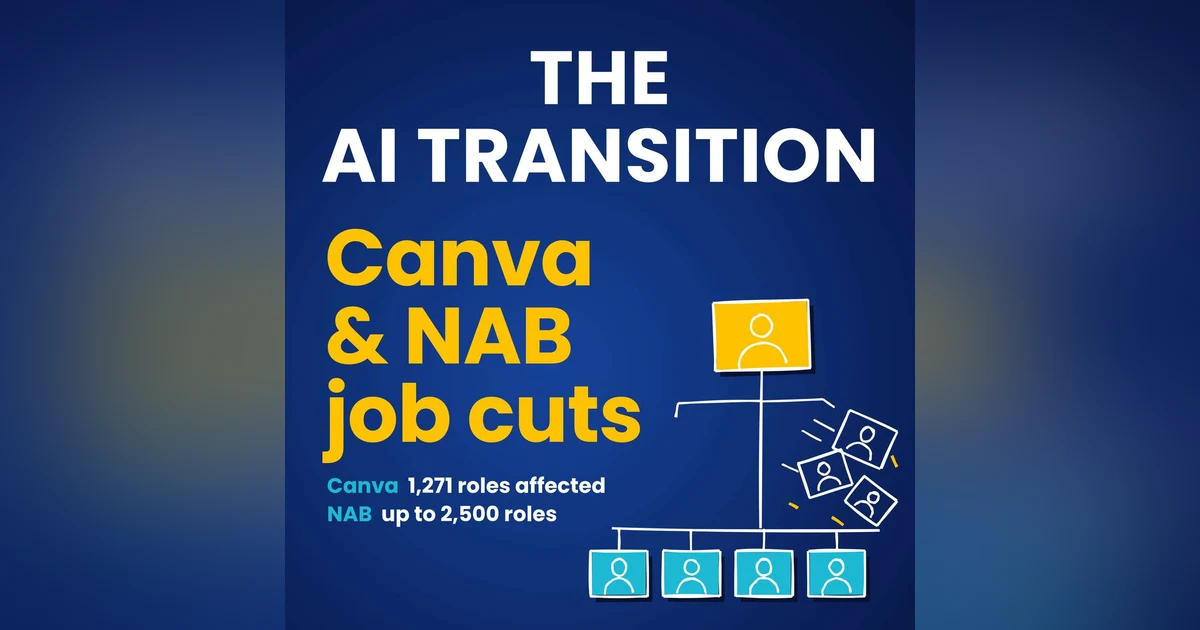

On Wednesday, Canva's founder told staff it was the hardest moment in the company's thirteen-year history, announcing a restructure that affects 1,271 roles, or 22% of the business. A fortnight earlier, NAB said up to 2,500 roles would go. This week, after pushback from staff and the union, it moved its forced redundancies to late January. They're still happening. Stephen and Lauren have both worked at NAB, so they start there: the Christmas timing, the results, spill and fill, and why neithe...
On Wednesday, Canva's founder told staff it was the hardest moment in the company's thirteen-year history, announcing a restructure that affects 1,271 roles, or 22% of the business. A fortnight earlier, NAB said up to 2,500 roles would go. This week, after pushback from staff and the union, it moved its forced redundancies to late January. They're still happening.
Stephen and Lauren have both worked at NAB, so they start there: the Christmas timing, the results, spill and fill, and why neither company will put the word AI in its announcement. Then Canva, a thirteen-year-old company rebuilding around small, empowered teams and fewer layers, bringing more of its people back to Sydney, and offering a far more generous package than usual.
Why are two companies doing the same thing so differently? Age, size, and how much one founder can decide in a week. Plus the people who stay behind, where the work goes, and why for both companies this looks a lot like survival. And Lauren's joke.
Disclosure: Stephen uses Anthropic's AI tools every day. Claude Opus 5.5 helped prepare these show notes and the episode art.
Watch the video: https://youtu.be/bHxNNSatCKU
Read more: https://www.aitransition.com.au
Chapters
00:00 Two restructures in a fortnight
01:38 Our NAB years
03:31 What's happening at NAB, and the Christmas question
05:04 What's being cut, and is it AI?
07:15 Bracing for turbulent times
08:33 Spill and fill
10:57 Canva refounds itself
13:33 Back to the office
16:29 Why Canva's under pressure
18:06 Why the two approaches differ
20:00 Fast or slow?
20:44 The packages
24:21 The people who stay
27:10 Survival
28:19 Lauren's joke
Sources
- NAB, 20 Oct 2026, simplifying its operating model: https://www.nab.com.au/news/nab-updates/nab-simplifying-operating-model-and-alignment-to-customer-priorities
- Finance Sector Union, 3 Nov 2026, no forced redundancies before Christmas: https://www.fsunion.org.au/nab-backs-down-no-forced-redundancies-before-christmas/
- HRD Australia, 5 Nov 2026, NAB puts pre-Christmas job cuts on hold: https://www.hcamag.com/au/specialisation/change-management/nab-puts-pre-christmas-job-cut-plans-on-hold/596235
- AAP, 5 Nov 2026, NAB's full-year results: https://michaelwest.com.au/big-banks-profit-drops-with-lift-in-loan-loss-charges/
- Capital Brief, 20 Oct 2026, NAB on the AI link: https://www.capitalbrief.com/newsletter/nab-and-tuck-5626eb05-43ec-4f27-a4bb-e90fc681ecaf/
- Canva, Melanie Perkins' note to staff: https://www.canva.com/newsroom/news/canva-team-update/
- ACS Information Age, 4 Nov 2026, Canva's restructure: https://ia.acs.org.au/article/2026/canva-cuts-jobs-in-major-restructure-affecting-1-200-staff.html
- TechCrunch, 4 Nov 2026, Canva and slowing growth: https://techcrunch.com/2026/11/04/canva-lays-off-over-1200-people-amid-slowing-growth/
- IBTimes UK, 5 Nov 2026, Canva's package: https://www.ibtimes.co.uk/canva-layoffs-six-months-pay-macbooks-10000-grants-1830275
The AI Transition is hosted by Stephen and Lauren. We cover AI developments with honest, human-centred analysis — no hype, no doom, just the questions that matter.
Subscribe wherever you listen to podcasts.
Follow us: https://www.aitransition.show/
The AI Transition is a People Over Process production.
You still matter. At least for just now.
On Wednesday morning, Canvas founder told her staff it was the hardest moment in the company's 13-year history, announcing a restructure that affects 1,271 people, 22% of the business. Now, a fortnight earlier, NEB said that up to 2,500 roles would go. But this week, after pushback from staff in the union, it delayed the force redundancies until late January. But they're still happening. One is a bank that's been chasing efficiencies for decades, and the other is a design company being squeezed by the very technology itself. And neither of them put the word AI in its announcement. So Lauren, if you're the one getting the calendar invite, does it really matter whether it's AI or not?
SPEAKER_01God, that is such a good existential question, Stephen. Look, part of me is like, no, but but yeah, being made redundant because a robot has, you know, uh created some efficiencies and removed the human element. It's extra sting in the tail, isn't it?
SPEAKER_00It is. Although we should say here that both companies are denying that it's AI, but we'll get into the reasons why we think, well, I think it's probably actually playing a significant part here. They're both denying it, maybe because they actually can't say that these days, because that would just be too toxic.
SPEAKER_01Yeah, I agree. And look, I think having worked with these large organizations, you do see them constantly restructuring, right? So that one's probably a little bit of a you can maybe hide between the cracks there. Whereas the other, the very product that you said in the intro that it sells, you can see the capability coming through AI now. So perhaps less surprising. And I must confess I didn't realise how huge that organization was until I saw those numbers.
SPEAKER_00Yes. Yes. Let's dive into NAB first. I'm going to go to go to some of the details there and then we'll go over into Canva. Both two very, very different organizations and with slightly different approaches until they've approached all of this. Before we start, have you been at NAB before?
SPEAKER_01Stephen, this is where we come and confess. I have actually I've had like a number of stints at NAB, and I have to say, very fond memories. Um really good experience working with them, um, doing lots of actually transformational projects um across the business and lots of good pals. There's some affected by this restructure, actually.
unknownYeah.
SPEAKER_01What about you, Stephen? Have you worked with?
SPEAKER_00So I so I have. And actually, due it was my probably my first big break in this transformation stuff going back 20 years and when we were rolling out the our first large-scale agile scrum transformation. We were using all the buzzwords. Um and it again, very fond memories, up until the point where the GFC hit and everyone gets sacked. But apart from that, it it was it was quite good up until that point.
SPEAKER_01Yeah, I remember being at the Docklands, we put a bunch of um business bank applications in the cloud. Shout out to the folks I did that with. And literally kind of watching the pandemic roll in. So it was such a surreal experience um to be there on the cusp of that event with that organization and how they actually handled it quite well. Anyway, we segue. We are segueing.
SPEAKER_00We did. Although the last little bit on that, I was also in Doc Lance, but I was at ANZ watching the pandemic roll in basically across the road, probably doing something very similar, but in the blue bank rather than the red one.
SPEAKER_01Well, you know, there's a tunnel that connects the blue and the red, right?
SPEAKER_00Well, so there's actually there's a whole circular tunnel that goes around the whole of Melbourne as people go from one company to the next.
unknownExactly.
SPEAKER_00Uh but let's dive into the details of what has actually happened at NAB because it it's a lot. Uh you know, two and a half thousand roles, you know, six percent. There's actually, I was reading today, there's potentially another one thousand roles that are going to be added to that uh in the next financial year. They were going to be letting a lot of those staff go before Christmas, but there was some negotiations with the with the unions there predominantly who got it pushed back till the end of January. And there was a classic quote from the from the NAB CEO basically saying, I'm really glad the unions brought it up, brought it to my attention that people were going to be let go just before Christmas. And yes, it is a better idea to make it the end of January. I was like, really, really?
SPEAKER_01Have we lost touch completely? There's this thing called a calendar. I mean, we're all aware of the day. Yeah, it's wild, isn't it?
SPEAKER_00And I I I've seen it so many times as well, the people getting let go just before Christmas. Uh and especially for those who are not in Australia, basically Australia shuts down from about the middle of December to the end of January, as it's all summer holidays. It's like the French disappearing in August. Basically the same stuff happens in Australia. So if you do let go before um before Christmas, the chance of you getting something else, you're into February, March at the earliest. Because there's no chance.
SPEAKER_01It's a real dead zone across that time. And dare I say you've worked really hard all year. You're you know, bracing for that break. Um it's the look, it's never a great time to do this, but particularly at the end of the year. Yeah, it's rough. Pushing it out to the end of Jan. I mean, you you kind of now know. It does give people some breathing room, I guess. Um yeah. But it's still rough.
SPEAKER_00Still very rough. So so the announcements is saying that you know, uh what's been cut are things like corporate functions, senior management roles, uh, fewer consultants, fewer contractors. But a lot of internal staff. So so no uh frontline customer-facing roles. But this is the kind of the behind the scenes, the real kind of development areas from our understanding, that's what's really being affected here.
SPEAKER_01It is. And they've you know, we're gonna contrast the different approaches here to um and again, like you said, nothing in the headlines around AI being involved, but we're now seeing more and more capability coming through. So one can assume we're starting to try and move towards some of that efficiency.
SPEAKER_00Um Well, I mean explicitly they have been saying there is technological improvements uh that are going to bring you know efficiencies there without saying that it's AI. So while it's probably technically true that AI is isn't taking full jobs, the idea is that they're not implementing AI type solutions that are making these functions more in quotes efficient, which means that potentially you need less people in there to do the same amount of work. I I think they're probably deliberately skirting around that because they know that if they put that out there, then there would be a firestorm around them.
SPEAKER_01Yeah, absolutely. And I guess there's a small the element maybe, I don't know if this gives any comfort at all, but when you're working with major bodies like banks, you do have heavy regs to kind of cover you and have the human in the mix in terms of a lot of these approvals and workflows. So you know, who's to see what will come out at the end of this in terms of where these have come or the shape that they're trying to get into? As you mentioned, there's been, you know, a few losses. Um maybe they're hunkering down and preparing for some difficult times. But I don't know. We've also had the blue wave in the States. Stephen, maybe there's going to be a big economical turnaround.
SPEAKER_00Well, yes. Although if we'd recorded this yesterday, there was a big bounce in the stock market. However, literally I've just been watching things just now.
SPEAKER_01There was a huge crash overnight, Lawrence, because of course I'm like mentally blocking a few of the AI bubbles that kind of burst in the last 24 hours.
SPEAKER_00So the AI bubbles look like they're kind of bursting from a stock market point of view over in the States, which will hit the broader stock market, which is going back to NAB, that's what they're basically saying is that they're preparing themselves defensively for turbulent times ahead. So they did release their own earnings this week. So their net profit was down just over 9%, their cash earnings down over 13%, although their underlying profit was up nearly 7%. You know, interesting there. But there are there are tough times ahead. And I think my reading, and we are certainly not giving financial advice here or predicting what's going to be happening, but there's clearly going to be turbulent times and challenging times ahead in the markets. And these companies are positioning themselves potentially with these tools that we're talking about in this podcast, in order to be able to kind of weather those storms.
SPEAKER_01Yeah, it again, we're all just surmising what's happening out there reading the tea leaves. Is that a Scottish thing to do, read the tea leaves, Stephen?
SPEAKER_00Uh it's more of an English thing if it's tea leaves, to be honest. I I I don't know. Is it the gazing at the bottom of the whiskey glass instead? I don't know.
SPEAKER_01Uh as long as it's not in a chocolate teapot, right? It's my new favourite Scottish saying.
SPEAKER_00Uh yes.
SPEAKER_01I'm c I'm all over the shop today, aren't I? Um But either way, I think the thing that stuck out as particularly kind of sucky in terms of this nab approach is they've gone with the classic spill and fill just the sting in the tail there of alright, we're cutting a bunch of rolls and you'll have to fight and reapply for your role.
SPEAKER_00Yes. Yeah. And look, we've been on both sides of that fence and it's it it's a horrible environment to be in. And it's also usually over an extended period of time as well. So there's months that it goes on. And I've seen some bad behaviour within there as well, if I'm honest, where the reason why you do that spill and fill is because there's certain people that you want to get rid of. And if you spill it all, well, they might just be the unlucky ones who didn't get the job when it's a very good thing.
SPEAKER_01They might just be.
SPEAKER_00I I've been told by senior managers in the past that this was deliberate policy in separate areas. Uh not in NAB, I hasten to add, but in other large organizations. That's exactly a policy that you would try and do. So uh not saying that that's happening here, but it's but it but it it's tough times. Uh and what we'll compare that to Canvas approach in a minute. But this is this is the kind of the classic we make an announcement, there's going to be consultation, there's there's three months, there's spill and fill, um, you know, etc. So it's the classic big corporate, and a lot of that has to follow uh legislation. So don't get me wrong, and a lot of that is right, but it makes what's happening from a people point of view, because you know, this podcast is all about the people as as it should be, these are really tough times to live through.
SPEAKER_01Absolutely. And again, that's the one of the strengths of the banks as well, is they do have quite a strong union. Again, I'm not particularly close to it. I've always been, I guess, an external coming in. Um, but the unions, you know, uh coming in and supporting their people to help make sure they get a fair deal. Um when you hear that CEO, oh, you're right, actually, it's the end of the year. Like it they really do need that support.
SPEAKER_00Uh yes. I and you'd have thought surely there would be somebody within an organization as large as NAB who could have made that decision beforehand to say, you know what, let's do this in February rather than December.
SPEAKER_01Give people a break, refresh, come back, see where we're at. Yeah. Anyway. If we were in charge, Stephen.
SPEAKER_00Indeed, that's the problem with the world. If only the pair of us were in charge, everything would be fine. Yeah, maybe not.
SPEAKER_01People shudder in fear.
SPEAKER_00Exactly. Well, let's shift over to an organization, Canva, which you know uh neither of us have worked at, but it's the sort of organization that we both have either worked for or would like to work at because over the over the years it's a progressive organization. They're they're uh you know adapting a lot of new ways of working, they've only been around for just over a decade. You know, it's not like the banks are with you know, kind of 150-year worth legacy there. So this is uh an organization that's going through a real kind of uh uh step change or uh ECG no sorry uh not ECG. Great band.
SPEAKER_01Or am I thinking of ASG? Wait, we're all getting muddled.
SPEAKER_00So I was I was I was more thinking of the shock to the heart treatment that was going to go. Right.
SPEAKER_01So I think it is a you think you had it correct the first time.
SPEAKER_00Did I? Well, excellent, right? So this is a significant to cut like a fifth, just over a fifth of your workforce. That's a big call. Uh but there's more to it as well. What I th what I found interesting was that they've been a bit more transparent about what's actually going on and what they're doing. And it's and it's really around a whole ways of working, different approach of small empowered teams, freedom to decide and take ownership of their own stuff, so kind of you know, distributed leadership, cutting out those middle layers, uh less subspecialization, so more kind of really good generalists, uh, more time building, less time navigating how work gets done. You know, all it you know sounds all great, right? And you know, and we do a lot of this stuff and have done for decades, but it's also really wrapped up in thousands of people losing their jobs as well.
SPEAKER_01Yeah, and like I said at the start, I must confess I didn't realise how large Canva had got. You know, this is nearly 1,300 roles that are affected, like you said, just over, you know, 20% of the workforce. Um, and I must also confess, maybe not so surprised as well in terms of how powerful, particularly when you think about Canva, you think of the cutting edge design tools and how even a lot of people, you know, my partner and family members included, you know, have Canva helped them, you know, on their phone get through their creative process. And it's been so amazing in terms of giving you some very simple, obviously complex in the background, um, design tools. So when you think about the capability, you know, with your free AI tools out there now, what the demand is going to naturally reduce. So though it's interesting to hear the, you know, wanting to refound Canva, but also they're pulling um a bunch of their team back to a home base in Sydney as well. That was, I thought, an interesting part of this story.
SPEAKER_00Aaron Ross Powell So it's also a shift away from the more distributed remote working to more face-to-face, co-located. It really is going back 20 years to what what we were what we were rolling out with the whole agile word, the previous A, which was the big thing.
SPEAKER_01Which is now such a polarizing word that we dare not speak, right? But there's some principles in there that I think, you know, still hold true. Granted, look, I'm a bit dismissive of that co-located. You know, the it's 26, we can collab wherever. Like if you bring people back to a space, we shouldn't all be sitting next to each other in petitions on Teams or Zoom calls. Like that kind of infuriates me. So when we talk about building a very expensive, I think $120 million building to bring everyone back, you're like, hmm, okay.
SPEAKER_00So it's not the it's not the Canva building, but I was listening to another podcast yesterday from Eli the Computer Guy. It was really funny. You should definitely have a have a listen to it.
SPEAKER_01Elon the computer. Eli the computer guy.
SPEAKER_00Elon, Eli, absolutely Eli. He was talking about the buildings when he was doing a lot of his senior consultancy work going back 10, 20 years, they were deliberately designed to make the corridors and the bathrooms in such an area where people would deliberately bump into each other in order to foster more communication across the organization and across different layers. So they would they would design where the bathrooms were so that you would be forced to have a conversation. And I it's not top of mind for me to be honest when I'm going to the toilet of wanting to have a chat, to be honest. But maybe that's just a meeting.
SPEAKER_01Oh, it's an interesting one to dig into it. I remember reading an article ages ago. But you know, the spaces where we would have the town halls where you know we would have, okay, it's Friday afternoon, let's bring everyone in. Um those spaces were designed to kind of cause stress and combativeness to get people, you know, fired up. Like, wow. So there's interesting background to some of the these methods. You know, we're refounding, but also here's a head office we want you to come back to that old trope of let's get eyes on the people.
SPEAKER_00Trevor Burrus, Jr.: So eyes on the people as they are no longer specialists because they're not specializing anymore, because probably the AI tools are the ones that are specializing. So they're coming in to keep eyes on the agents that are running around the building as well. I don't know. We're Wild West territory about how all this works. And and you know, and we know a number of organizations and a number of consultancies that are going through all of this that are saying that this is like Wild West. We don't really know we're we are trying experimenting. We don't know how all this works yet.
SPEAKER_01Exactly. Figuring it out as we go, blazing a trail. Um so we are in that. Would you call it, Stephen, dear God, is this the messy middle?
SPEAKER_00Yes, it is the messy middle now. With without a doubt. You know, we've I think already gone through some endings and we're in the messy middle, big time. Uh across society, across organisations, across individuals. And you I called it the Wild West before. All of those analogies are absolutely all true. And it's unclear what the path forward is going to be. If I was to bring it back to what you were saying about Canva and its use, what came up for me was you're absolutely right, it was the tool over the last couple of years, in particular, that for example, my daughters who are you know teenage daughters and going through you know senior school and the rest of it, I actually said to my youngest last week, uh she had to do a presentation at work. And I said, Oh, are you putting that in PowerPoint? And she looked at me like I was daft, right? And Dad's like, Dad, it's in Canva, obviously. And it's like, oh, all right, okay. Because that's the default that you know that generation are using. Although even her, to be honest, and increasingly I'm finding myself as well, what I used to do in Canva, I now just doing Claude and ChatGPT, right? For the simple stuff, to say, hey, can you edit this image? Can you can you create this? Can you mash these two things together, etc.? So instead of me doing it myself within Canva, uh, I will just ask Claude to do it. And they're probably reacting, even though they're not seeing it explicitly. That is definitely a part of this.
SPEAKER_01Surely what is. I mean, should we go back to the old days where you'd get it spend a couple of grand on a Photoshop license and Yes. Yeah, and then that's why Canva really cut through with just some really great simple functionality. But like you said, now we've got that disruption and you've got it coming through your AI tool of choice. So I know being in a lot of bands and you know, people spinning up their own merch, it really is a go-to tool. Um and look, with it's a whole polarizing conversation around AI slot with advertising that we could go down a rabbit hole on. But if we pull us back, Stephen, where were we?
SPEAKER_00Well, look, we've compared the two different organizations and their different approaches. And probably the last thing I would like to say about the why there's the different approaches. So one is I think the uh the age of the company. So if you've got an organization that's only kind of 10 years old, etc., compared to this 150-year-old company with you know decades and you know centuries worth of bureaucracy there, that's certainly part of it. There's different approaches. Another one is around just sheer size when you've got something of the size of NAB, then there's different approaches when you're talking of tens of thousands of people. Yeah.
SPEAKER_01Because there are about 45,000 employees versus about five. Yeah.
SPEAKER_00Yeah. So there's a there's a big, nearly a factor of 10 difference there that was going on. Another one though is, and certainly been my experience when I've worked at very large organizations and worked at very small organizations. One of the challenges in small organizations, which is a double-edged sword, is it's so highly people-based when it's a smaller organization, because especially in those senior roles, if you've got somebody who's really good and incisive, then it can be trailblazing and the support and what you can do is amazing. On the flip side, it can be horrific because you can never get anything done because one person says, No, and you're it's over. But what this sounds like is that the founder she decided that no, we're making this change. Uh, and literally it was done within the week. So it was done, they announced it. People lost access to their emails and and Slack within that week. Yes, they could keep their MacBook, but they couldn't log on to anything anymore. We'll come to the packages in a minute because that's interesting. But there was a speed here of Canva said, nah, we're done it. Very much a rip the band-aid off moment, probably, of saying, nah, if we're doing this, we're doing it big, and we're done. We're not spending months over this, we're done.
SPEAKER_01It did, it moved really fast. I remember reading the headlines and then logging into get out LinkedIn. And there's a bunch of people saying, Well, today's my last day. Like just really moved so fast.
SPEAKER_00So I don't know if you're in that situation. Do you want it to go faster or not? I mean I I was what came up for me was yes, I probably want it to go faster, but not if it was just before Christmas. I would rather it was going to be, you know, let me enjoy my summer holidays and you know, get my head in the game and talk to my family and work out what I'm going to be doing. But that getting it overdone quickly as well, sometimes with these dramatic changes, can be better.
SPEAKER_01And and again, it probably comes back to where that organization is this awareness that we're assuming around that cost cutting. But like you said, they took a bit of a different approach, whereas NAB had the spill and fill. Canva seem to have, you know, in terms of what they're offering their employees, it seems quite generous.
SPEAKER_00Very much so. They So NAB seems to be offering, you know, kind of standard packages, some consultation, maybe some redeployment, maybe bit of career transition support. We've seen and sort of live through this for twenty, thirty years. It's all very standard stuff, right?
SPEAKER_01I do not need to refer to my age again.
SPEAKER_00Sorry, Lauren, sorry, Lauren. Whereas on the Canvas side, quite significant difference. So six months of pay, you know, a year of healthcare, keeping their MacBook so they it's actually the physical hardware they've got, coaching and LinkedIn premium support, and then up to 10,000 US dollars to start something new to start a new business. So that's for supposedly for all the employees that they're letting go. That's a significantly more generous package than than normally would be offered.
SPEAKER_01Yeah, I think so. And it looks certainly some pals of mine that have been affected said, look, the six months does help because we all know it's a weird market out there at the moment because we are like we're just seeing this rise and you know, uh particularly AI just seems to be dropped into every new job title now. So it's a bit of a who are we in this new world? Um, and how we connect. So I think that obviously the six months helps. Although it was interesting. Um there has been hints too of a change in culture that's been going on. We won't go too deep, obviously, because it's all, you know. Um so it sounds like this change may have culturally been shifting for a while. And I did notice, and look, maybe it was just me. I kind of squirm when I read these things. The founder referring to the departing canva naughts.
SPEAKER_00Oh, yeah. That sounds doesn't work for me. No.
SPEAKER_01Could be a little bit more patronizing.
SPEAKER_00So that's so so so that goes back to kind of Disney and the imagineers, I think, that they have there. So it's like, mm-hmm, no, they're really not.
SPEAKER_01That's a whole nother conversation, isn't it? The culture culture at Disney. Anyway, we're digressing. So look, it it's either way, you know, hearts obviously go out to people affected by this. It's bloody awful, but it's just keeping across what's happening out there. Six months and also giving, I guess, being part of a grant. Like that's quite um I don't know if I've ever heard of that before, and keeping your equipment and trying to help you move forward. Um, maybe that goes a little ways to helping ease the pain of it all.
SPEAKER_00Um I mean, putting the the transition lens over both of this. I mean, as you were saying early in the messy middle, but that's recognising that endings come first within this and giving people time to let go of something. Because this isn't just jobs, this is this is like this is identity, this is purpose, this is friendships, this is this is a lot of stuff all wrapped up together. AI is probably at the heart of why they're off trying to find new jobs just now anyway.
SPEAKER_01And I I feel like most people now will have at least adapted to the basics of this tooling. I think it's more where you see there's huge enterprise-wide adaptations and even thinking about how you know shifting focus to smaller, you know, self-empowered teams, which like you said, harkens back to some patterns that you know we we've all seen before. But even that is a huge structural change in terms of, well, are you actually empowering these teams? Where does the decision-making land? So we've got some big numbers going and then uh you know, mention of big structural change, but that takes time, obviously, on the ground to get through and you disrupt everyone on the ground who's now seen some of their buddies go, or now they're fearful for their own own careers and their purpose. So huge disruption all around.
SPEAKER_00Let's also just briefly focus on what happens to the people who stay. Because I've been in that situation as well, where it's others who have departed and you're the ones who are left. Because that's also not easy. I mean, obviously you've got a job, etc., and you might have that financial security, but it's still not a comfortable position to be in.
SPEAKER_01Oh God, I'm about to try and take on the work of an army because that work is still needs to be done that's been left behind. Yes. Um so it's yeah, it's a lot to take on for those left behind as well. So where does the capacity go? Where does this work go?
SPEAKER_00Well, what's being thrown around us is that uh it's going to be uh less people doing more with these extra tools, right? So the expectation is that the productivity needs to go up because you're there's going to be more throughput. You have to throw around these lovely words, i.e., you're going to be working harder in theory, or are you going to be managing agents in order to push the work through instead? Is that the role? And so the role really changes from doing it to actually supervising something else doing it, not someone but something else doing it. This is this is the challenging environments to be in. And there's just that whole I mean something's ended as well, and you haven't walked away from it, but you're actually still there. And so you've gone through the ending. But that takes time. That takes, in my experience, three, six, nine, twelve months for that to kind of properly wash through the system.
SPEAKER_01Yeah. Culture, well, we know it takes years, but there's force adaptation. Like there's different ways to, you know, push change through, obviously, and that force adaptation. And you remember back in the days where certain who maybe won't mention the colour of the bank would push through these huge transformations, like, well, okay, well, now you'll insert the name of this new job title you've never heard before, and you just magically start working like that.
SPEAKER_00So tough episode, this one. I know, Steven.
SPEAKER_01We really there's it's hard to find some, you know, silver linings in any of this, except that maybe it's just more digging into this, thinking about what's going on, getting people, you know, sharing some of these stories about what they're seeing behind the doors. I mean, I always think we work with these large organizations that look, you know, when I think more about the nabs and the bigger banks, they do, they are generally a bit bloated, right? And they do constantly restructure, but it's really digging into this, going, okay, what's at the heart of this one? What's really going on, especially in the global economy. Obviously, you know, all the disclaimers that we're not financial advisors and all that sort of good stuff. But there's so much going on, and really what's at the heart of it, because we're trying to, as humans, adapt. We're trying some of us are just trying to bloody survive at the moment. Um, you know, see what's coming so that we can, you know, keep paying those ever-growing bills and mortgages.
SPEAKER_00Joe, I think the word you're right. Though the word for me is about survival, right? It's about survival of these two organizations in different ways. So, from an organizational point of view, you get two orgs that are trying to survive for what they see is coming. So they uh the bank seeing fundamentally much more challenging conditions coming up, and but there's and there's all these new opportunities in order to use these tools to maybe you know boost profits and be more efficient, etc. Canvas seeing potentially existential threats on the horizon of everything changing underneath. Uh let alone whether that's the company's survival, but it's but it's people's survival, it's their own personal careers, it's their livelihoods, it's their friendships and the rest of it. So, you know, adaptation is one word, but you know, uh I probably agree it's about survival at the moment for a lot of people. Sadly, I think that this probably isn't going to be the last episode that we do like do like this over the next couple of years.
SPEAKER_01No, we again we just want to, I guess, big part of this podcast is to try and stay ahead of of what's going on out there and analyze it and you know, see what's bouncing around to keep keep surviving.
SPEAKER_00So obviously you're going to fix everything, Lauren, by telling us the killer joke in order to get us through this.
SPEAKER_01Oof, this was rough, and I had to fall back on a few concepts. Um one of them was just that it was recently Halloween. That's how because there is nothing funny about redundancies or people losing jobs at all. So I dug deep into the classics here. Um actually, I maybe may have even told this joke in my nab days. Why did the vampire get fired from the blood bank, Stephen?
SPEAKER_00I don't know, Lauren. Why did the vampire get fired from the blood bank?
SPEAKER_01He was caught drinking on the job.
SPEAKER_00That'll do. That that'll do.
SPEAKER_01I gotta chuckle. I'll take that.
SPEAKER_00You did. You did. Didn't quite balance out the whole episode, but it but it but it started to. So that's all that's all that's all I'm left.
SPEAKER_01Hold on to the dad jokes. We're still telling dad jokes, we've we're still surviving.
SPEAKER_00Thank you very much, Lauren. Um we will be back soon uh with uh hopefully more upbeat and cheery messages, but I thought it was important to do this one, especially in an Australian context, you know, where we're we're both here in Melbourne, we've got a lot of friends, etc., that have been impacted by these by these by these announcements. You know, this is getting very real out of all of this. So thanks everyone for uh for listening, subscribing, liking, helping us out. It really makes a difference. And if you can pass this on to someone, hopefully this makes a little bit of a difference, gets you a bit more curious, gets you to go and find out some more things. But most importantly, and really want to emphasize this one is to remember that you still matter.
SPEAKER_01We still matter, absolutely. And not just for now, like no, just all the time.
SPEAKER_00All the time. Yes, yeah, indeed. Thank you, Lauren.
SPEAKER_01Thanks, David.