


 Apple Podcasts
 Spotify
  RSS Feed
 A Tale of Two Data Centres
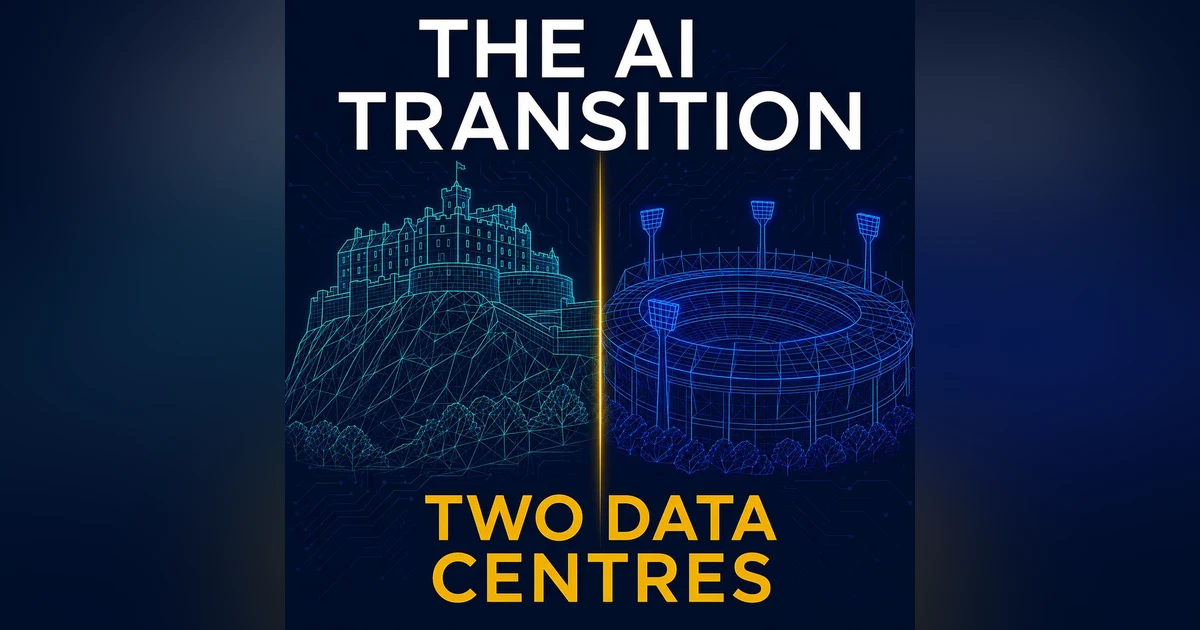
225 megawatts. 14 football pitches in size. Approved, funded, operational. 210 megawatts. Refused. Unanimously. Two data centres. Two cities. One question nobody wants to answer.
CHAPTERS
00:00 — Intro
02:26 — Melbourne
10:39 — Edinburgh
19:06 — Big Picture
27:20 — Wrap Up
REFERENCES
Deep Dive Podcast Companion
https://www.peopleoverprocess.com.au/podcast/deep-dives/ep7-two-data-centres
Melbourne Data Centre Boom & NEXTDC M3
https://www.theurbandeveloper.com/articles/data-centre-knight-frank-report-september-2025-melbourne-sydney
Edinburgh South Gyle Proposal & the Green Data Centre Policy Problem
https://aprs.scot/news/update-on-data-centres-campaign/
Energy Bottlenecks & the Off-Grid Shift
https://www.morganstanley.com/insights/articles/powering-ai-energy-market-outlook-2026
Global Energy Demands, Water Usage & AI Regulation
https://www.brookings.edu/articles/global-energy-demands-within-the-ai-regulatory-landscape/
AI Data Centre Power Constraints & Build-Outs
https://www.pewresearch.org/short-reads/2025/10/24/what-we-know-about-energy-use-at-us-data-centers-amid-the-ai-boom/
https://www.iea.org/reports/energy-and-ai/energy-demand-from-ai
The AI Transition is hosted by Stephen and Lauren. We cover AI developments with honest, human-centred analysis — no hype, no doom, just the questions that matter.
Subscribe wherever you listen to podcasts.
Follow us: https://www.aitransition.show/
The AI Transition is a People Over Process production.
You still matter. At least for just now.
It was the best of times, it was the worst of times. One city, a patch of industrial land, 10 kilometers west of the CBD, 14 football pitches, 225 megawatts of power, approved, funded, operational. Another city, a disused office block, a former headquarters of a bank that no longer exists. Eight football pitches, 210 MW, proposed, debated, views unanimously. Same technology, same scale, same decade. One is in Edinburgh, one is in Melbourne. And between them, they tell you almost everything you need to know about where artificial intelligence is actually going. Not the software, not the models, not the benchmarks. The physical world has to hold the weight of all of it. The land, the power, the planning committees, the people who live next door. We're in the middle of the largest infrastructure build in human history. These are the factories of the 21st century. And like every industrial revolution before this one, it's not arriving evenly. One city got the boom, one city pushed back. And I've lived in both of them. This is the AI transition. I'm Stephen, and with me as always, Lauren.
SPEAKER_00Stephen, how are you? Oh my god, two of you cities you've lived in.
SPEAKER_01I know, I know. So Edinburgh and Melbourne, and two two very different um cities. Although, actually, bizarrely, this week their weather is exactly the same because I just looked it up, and so Edinburgh, height of summer, 19 degrees in rain, and Melbourne, height of winter, about 19 degrees and a little bit of drizzle. About the same.
SPEAKER_00It felt a lot colder than that this morning. It's summer though, right? Summer over there. I was gonna say which one's your favourite. Let's make it awkward. Um I do that too. Well, this is an interesting topic, Stephen, and I I must confess, I I think you might be ahead of the game a little bit of me here. Like have been madly brushing up because it's so much to read about it at the moment, so many things in the headline.
SPEAKER_01There's look, there's a lot of technical stuff within this, but there's some broader questions to debate as well, right? So I think what we'll do this episode is like we'll lay out what we understand is happening in both Melbourne and Edinburgh, and then try and bring it together of well, what does that mean more generally, and and try and stitch it together to the bigger picture. Because these are really, really big in both cities, and it is getting some traction in the media, etc. But to be honest, from my point of view, not the traction that it probably deserves, but the scale of what's going on. I think that's that's the thing. It's the scale.
SPEAKER_00And that's what's been on all the headlines. There's huge, particularly in Melbourne, um, where we've seen usually Melbourne's in the shadow of Sydney in terms of, you know, land and power constraints and just the size of some of these. Um, however, we've seen the launch not too long ago now of a huge facility, the next DC's M3 facility in West Footscray. 41,000 square meters of tech space. Purpose built for high-density AI computing. And this is in our backyards. And fun fact, Stephen, you ready? I was born in Footscray.
SPEAKER_01Oh, I didn't know that.
SPEAKER_00Look out. Speaking of home cats.
SPEAKER_01From uh Australia context, MCG, which is really, really big. Um, that whole MCG complex, this is one and a half times the size of that. So this is quite a big area in West Footsgree.
SPEAKER_00Um, just massive. And there's again lots of reports in your YouTubes and the media in terms of the size of this and the noise for the local residents where you know you're living in an industrial zone, but you kind of don't expect this behemoth to kind of, you know, erupt um in front of your house in some cases.
SPEAKER_01So this is in the this in the backyard of West Footsgree, which for for those who don't know Melbourne, this is right in the heart of the city, right? This is out in the west, uh more of an industrial area, and but it's still within the city bounds, right? And we're putting very, very large data center right in the middle of the city. So this isn't like in some other parts of the world, particularly from what I'm seeing in the States, where a lot of these data centers are getting located more in rural locations. This is happening right in the city, and it's the first of many that's planned for in the city as well. Uh number of reasons for that. It's to do with the the the grid supply, the access to resources, both people and and and physical. I I do like the fact that you know we're overtaking Sydney on this. Although is this a good thing to overtake Sydney on?
SPEAKER_00I don't know. I don't know. And that's where it starts to get interesting, right? Like how we have all of a sudden overtaken Sydney, and this is where the power supply comes into play, where this isn't an industrial site, but you still have you know um housing with this huge data center right at the front of their house. So there's some interesting background here in terms of how long it takes you to actually be able to stand one of these up. Fun fact, not very long. I think you can stand them up in about 18 months. But the challenge is actually connecting to the power. And that's what's happened in Sydney. So it's a capacity overflow problem. So usually Sydney is where the data centers are at. So they've got the Opera House, Stephen, they've got all the data centers. This isn't the way to creep on a parpon Lemo Melbourne, just food for thought in terms of tourism. This is not it.
SPEAKER_01I don't think there'll be or maybe there will be tours in the future that's going to Westfoot Gray to point at the data center where it all began. I I I I don't know.
SPEAKER_00Yeah, so Sydney is literally it's run out of grid, basically, um, in terms of standing these up. So we've had to find somewhere else to put these. And we've gone, this is next EC, um, the M3 facility is in Westfoot's Gray. So this is a massive 41,000 square meters of technical space, purposely built for high density AI computing, feel the power. And some of the neighbours are actually, in terms of talking about how loud these things are.
SPEAKER_01Yep.
SPEAKER_00And how close they are to their houses. So they there's resonance. And let me know if I'm going too deep, Tracyon. Stephen, keep me honest here.
SPEAKER_01No, but I was actually going to balance it and and and maybe we'll we'll play the opposite here from what we normally do. But but here's a potential upside to this, which which is this might sound counterintuitive, but because these facilities consume so much power, right, and they're getting concentrated with within within the Melbourne area, you know, uh counterintuitively, the fixed costs for electricity, so a lot of when you pay your electricity bill, maybe a third to 40% of it can be made up of those fixed costs, though those grids and components, right? That's actually going to be paid for mostly now by these data centers. So what it might actually do is that the more data centers they build in Melbourne, it'll actually lower electricity prices for consumers generally, if they manage to keep up enough of the renewable supply coming in from the rest of rural Victoria. Right. So so it's kind of balanced on that. But so there's a potential this might actually lower electricity prices, which I find really strange.
SPEAKER_00Yeah, it is boggling when you think how much power they actually take to run this facility. It's equivalent of running um, I think Ballarat is one of the stats that I've read. The amount of power going into these things.
SPEAKER_01Yeah, and and for the for those who are not aware of Barrelat, so it's a small town's worth of you know electricity that it needs. And I just also kind of set the concept of the scale of this going forward. Well, this is massive, and you know, we're saying you know, 41,000, and but what that actually means is that 14-size, full-size football pitches, right, and of that, something like eight of them are just the racks, right? So just servers. So just think of you know, rows upon rows upon rows of all of these computers all humming away. Uh but this is only one of 24 data center projects that are currently in the pipeline right now for Gemini, who are the local electricity supplier. 4,000 megawatts of capacity, right? And just to put that in scale, that's four times the size of Gemini's entire current summer peak demand in Melbourne. We're talking something that's four times higher than the peak demand that happens in Melbourne as a baseload that's going to get it consumed. And they think that's going to be within the next three, four, five, six years that they're going to stand that up. This is incredible scale.
SPEAKER_00That is wild. And the interesting thing too is as soon as they stand them up, they're actually immediately being used. There's so much demand in terms of that power with AI computing.
SPEAKER_01So Well, there is, although we'll come back to that maybe in the last section as well, right? Because that's maybe one of the things that you know is this a build and they will come, or a kind of more Jeevin's paradox where the more that you have, the more that it's wanted, and there's that kind of snowball effect. Um there's certainly demand just now for this data center. Whether there's the demand there for all of these 24. 24, yes.
SPEAKER_00Let's let's met that pull that down a little bit. It's it's also interesting all the investment side of it as well, because it's one of the largest investors in the world buying all these different companies up to actually establish these facilities. So Blackstone made this huge purchase, uh, $24 billion to buy airtrunk. So again, this is to try and get that competition in the sector. Largest ever transaction in Australia's digital infrastructure sector.
SPEAKER_01So these are really large investments, which for this time aren't just these mythical ones that seem to be happening on stock markets. This is real infrastructure, real huge buildings consuming huge amounts of power that have been greenlit so far in Melbourne, that are getting built. There's been some backlash, but it's been approved, it's up and running, not in full capacity yet, but it's on its way, um, with lots more in the pipeline to come for Melbourne. Sounds like a bit of a transformation that's in people's heads anyway, of you know, why are you building this much so quickly? Something's coming.
SPEAKER_00Definitely. And and like you said, the the investment's there and the boom's real. But the interesting part of this is that the grid is under strain. And this is where we'll dive into this a bit later, how we've got some companies working around this with some shocking solutions.
SPEAKER_01Uh yeah, we'll we'll save that one for the last bit. It did shocking. Excellent. Yeah, yeah, yeah. You're building up your big joke at the end, hopefully, Laura.
SPEAKER_00May have peaked already. May have peaked already. Yeah, so look, there's a bunch of technical constraints, but you know, maybe we won't won't go there yet, Stephen. We've already gone pretty deep. So I guess the headline of this all is massive data center in the heart of Melbourne, probably like 15, 20 minutes from the CBD, and they're springing up all around. What about your hometown? Is it your hometown?
SPEAKER_01Well, it's actually not my hometown, but it is if it is my partner's hometown. I wasn't born there. I was actually born in the other side of the country. And if you know, a Gleswegian saying that he's his hometown was Edinburgh, that would be just a a step too far, to be honest. But I did go to university there and my partner is from there and all her f all her family as well still live there. That's pretty much it. So uh it's probably your hometown. I yeah, no, so I I kind of grew up when inverted quotes in Edinburgh because you know that's where you know I left home and you know discovered what the formative views. Let's talk about your formative views statement. Maybe not, maybe not. Okay, back to the But we do need to keep this certification uh of this podcast at the right rating, to be honest. So maybe not into those stories yet. Okay. Um so I data centres, data centres. Data centres. So this one is um uh equally sized data centre that's been posed for for what's called the Guile Centre. Now, this is on the ring road of Edinburgh, so it's not as much in the city centre. Although, if you know Edinburgh, it's basically got the castle and all the fancy streets around it, and that's the city centre and Princess Street and all of that fancy stuff is is in the is in them is in the middle. And then the other stuff is pushed out more and more to the outside, so it's a bit different to Melbourne, the way that it's set up. It's also incredibly smaller size-wise. So probably Edinburgh's about the size of West Footsgrade, to be honest. Um, I think the the population of Edinburgh is in the kind of 250,000 to 300,000 sort of mark, whereas the population of Melbourne is over five million these days, right? So um there's already a kind of scale difference there. But two amazing cities.
SPEAKER_00I mean, castle. Castle in the center. Yeah.
SPEAKER_01Yes, yes. Although, fun fact, we knew someone who went to the castle two weeks ago and turned up and just hoped to go and see the castle, but found out she needed to book weeks in advance in order to get a ticket and wasn't allowed in and had come from Australia to see the castle. Seems a bit off, to be honest. But anyway, so the Guile proposal. Uh this is a 212-megawatt facility. Prior priority development is meant to be getting put in there. Um this was based actually on a on an old planning framework from only four years ago from 2022, where they classified data centers as being green, having negligible in impact on greenhouse gas targets. And this is how it's kind of sold into into Edinburgh. That those data centers that were envisaged only four years ago were envisaged to be about 10 megawatts in size, right? Not the 210 megawatt proposal that actually happened. So that shows you, again, just in four years, they thought data centers were going to be 10 megawatts. Oh, that'll be green. They're now 210 megawatts, and they're still trying to pretend it's green, and people are going, uh, this is this is this is like 20 times the size. Is this really green? Really?
SPEAKER_00Apartment buildings that are springing up in residential areas and a bit. But again, look at me trying to digress again. Um and they they thought it was gonna be a green initiative, Stephen. This is interesting.
SPEAKER_01Well, that there was a big part of it, because actually Scotland has a huge amount of renewables. Um, you know, what one of the bonuses, it might not have much sunshine. I'll give you that, right? Not a lot of sort of things.
SPEAKER_00I was gonna say, where are they getting the stuff at learning?
SPEAKER_01Look, it's mainly from wind, because there's a lot of wind. Tell me about it.
SPEAKER_00A lot of wind. Well, no.
SPEAKER_01So both onshore and offshore, um, and you know, huge amounts of renewables there, a lot of hydro as well for from pumping down from the highlands. Um there is some solar, it does it is sunny at times, occasionally. You know, Scotland is basically 100% renewable, it's just when it's tapped into the whole UK grid, then it's not. So there's a lot of renewable power that can be put into these data centres. But whether that amount of power is enough to actually uh back data centres of this size, which is one of the reasons why it's now run into problems. So this one has now been um disapproved um so far. So lots of objections and it's stalled. So they are not building this as yet. So this capacity, this compute capacity, which will be here in Melbourne, you know, very shortly, isn't going to be there um in Edinburgh and and in Scotland until a lot later until it gets through. There's a lot to unpack there of, you know, is that a good thing? Is it what Scotland's doing better and pushing back? Is it better that Melbourne gets the compute capacity in order to push along from an economic point of view? No matter what, it's big on on on both sides, the the the calls are being made.
SPEAKER_00Huge. And I I I think, you know, to touch on that as well, there's the interesting dilemma too with these huge complexes when they they do need that power capacity constantly. So when power goes out, what they fall back into is the is the rub at the moment in terms of, you know, for example, in Footsgrade, there's 40 diesel engines that kick in. Yes.
SPEAKER_01And that's what they're proposing for Edinburgh as well, is that it's actually diesel engines. Um I believe a number of data centers in the US, um particularly the ones that Elon Musk have spun up, um, which I believe just riding over any planning disapprovals, etc., he's just kind of run roughshod over it and just done it. He's just um carted in big um gas turbines and diesel generators in order to power these data centers um entirely, like off-grid. Having these diesel generators running, they were estimating that when they're running in Edinburgh, it'd be the equivalent of uh having a hundred thousand idling diesel cars when these generators are on. Now that's a lot. So if you can't guarantee the electricity supply in on a regular basis, and you are actually having to go towards backing things up with diesel. That's quite a lot, and I'm I'm thinking it's probably failing on its green credentials somewhat here at that point.
SPEAKER_00And you know, the r there's a recent thing that's been happening that's really pushed up the price of diesel fuel as well, needless to say.
SPEAKER_01There's been a little war going on, I believe. Somewhere about half a foot. We're gonna talk about the war. Um, although I believe today again it's all over. So so there you go. So um sorted. Yeah. I assume you know who solved it. Um we've got two very large data centres. Um They're only the beginning of the pipeline of the stuff that's coming through on both. You know, one got fast track and approved, basically in Melbourne, with not a lot of talk and discussion, to be honest, from what I can see. There's been a little bit in the papers recently, but maybe a bit late. In Scotland, more of an issue, and it ran into more issues, more stringent planning and conditions there. Um it's a real challenge. It's a real challenge politically, it's a real challenge from uh from a from a grid point of view. Um but one thing I would say with both of them is that the it's the size, and really want to re-emphasize to people that the size of what's getting proposed here. These are the modern day mass factories of the 21st century. That this is the new factory complexes that are getting built right now. And they don't have any people in them, uh which is maybe one of the drawbacks. But they're big, really, really big.
SPEAKER_00Massive. And it's it's also interesting too, like the big challenge at the moment, obviously power, but also one that we're not talking about much is water. So, you know, we hear a lot about the water required to run these. And we're looking in Australia alone, the water demand to more than triple, which is a real hidden resource constraint that you know really gets airtime because it's understanding how do we actually cool these data centers. There's a lot of water involved. And in a country that's you know struggling with drought.
SPEAKER_01And we're about to go into Super El Nino, it looks like as well.
SPEAKER_00Super El Nino.
SPEAKER_01So things are about to get very warm, basically, over the next 12 months. Well, I would say that maybe on the water one. I think Scotland will probably be okay with the water, just with the rain. You could just you could just have some buckets out and just be throwing the buckets on regularly. Um actually really interesting. Um China just opened up a new data center um uh I um um off the coast. I think it was about 10 miles off the coast, and it's an underwater data center that's getting cooled by seawater, and it's actually um something like 15-20 meters underwater data centre, and it's uh naturally so much cooler, they need so much less power. Um all the water's there because it's you know it's in the middle of the sea. Um really interesting solution that China's come up with.
SPEAKER_00Wow. It's it's honestly mind-blowing, isn't it? And this is just what you can kind of you know find online at the moment, too, in terms of what's coming through. But interestingly enough, in in the States, you know, thinking about those power constraints and where they're building them, there's uh a number of them that are actually operating below these critical safety margins, they think by 2030. A blackout risk is this huge issue in terms of deploying AI and planning for it. So you need access to power, and there's a huge wait time because of the enormity of that power in terms of how the grids are built. And then depending where you've actually built their structures, you could put you know major cities and towns nearby at risk of blackouts, let alone actually deploying your AI solutions.
SPEAKER_01And interesting, scary, very full-on fact that just happened over the weekend um that hopefully people have seen in the news. Fable five, which was uh Anthropic's new model, the their their top-of-the-line model, was basically pulled and cancelled by the US government on Friday night. So for the last three days uh of of this recording, um you cannot access Fable V anymore because it was deemed a national security risk and could only be used by US citizens and not by foreigners. And that includes foreigners who worked for Anthropic who built the thing. So the foreigners who built the thing are no longer allowed to use it. Cancelled by diktat by the US government. So where I was going with that was that um just say you build these data centres and it's running on one of these models, and you've built your whole economy on these models, and then there's a decision made in Washington by either side of the political divide to say, actually, do you know what? We're shutting that down. And then that's it and it's gone. It was gone within 90 minutes of that of that decree going out. So the the model was pulled. If you've built your economy on top of these models and you're building these massive data centres, but you have no control over what models you are and aren't allowed to use, that's getting done on the other side of the planet. But is this a safe place to go from from an Australian sovereign or any other country's point of view, apart from America? Um that's a bit scary.
SPEAKER_00It is. And again, just another example of how fast this is running. Like we're we are building these so fast and you know, cancelled by the US government. Uh and then on the same other side of the coin too, you've got the SpaceX AI. It's just been IPO'd for $1.7 trillion.
unknownYep.
SPEAKER_01Yep. And and supposedly 95% of that IPO was based on the AI component of SpaceX. So it's not actually about the the satellites, etc., and the rockets. Nearly all of it has all been about the uh the the AI that's getting built. And Musk said that there's an addressable market there of twenty-seven trillion billion squidillion dollars that um that SpaceX is going to then take over in the next couple of years, and he's now a trillionaire. Um, all based on this data center build out that's now made him the first ever trillionaire and the most powerful person that's ever existed, with the most money that that's ever existed. How do you justify these sorts of valuations? On one side you've got the same, well, this is gonna just super Boost the economy so much, there's going to be this amazing tool for everyone. That the stock the the all economic output is going to be factored by 10, so much better, everything is just going to be incredible, everyone can do everything, and the whole economy is going to boom and it's going to pay for all of it. That's that's the happy path, supposedly. The other path is the only way to justify this is that the spend, you can only justify that by the replacement of jobs that are no longer getting done by people that are now getting done in data centers. So one of these two things are probably going to be true or some mixture in the middle. Whatever it is, it's huge. And this build out underpins that um massive size of what's going on.
SPEAKER_00I know, which really does keep you up at night. But it's it's interesting too when you look at who's paying for all of this in the backhand, like you said, like these huge insert whichever phrase you want to insert for these kinds of people. Like even in Australia, where you've got these, you've got AirTrunk, right? If we link back to the start of this, is Next DC's direct competitor, right? Now, you've got Next DC, they're locally listed, right? But Airtrunk, which also has a Melbourne campus, so the biggest competitor, it's now owned by Blackstone. It's one of the most powerful private equity firms on Earth. And it's backed by Canadian pension money, of all things. So looking at where this funding's all coming from, it is hedging its bets against that scary scenario we were talking about before in terms of I don't even want to say it. Placing the humans.
SPEAKER_01We don't know where this is going to go. I I don't think anyone knows which which direction this is going to go. When we're saying it was a tale of two cities, it does hark back to that potential Dekensian moment. You know, is this going to kind of huge inequality of kind of Dekenzian type times, or is this tale of two cities where you've got a very different outcome based on embracing and grabbing this opportunity? Does this mean that Melbourne is going to boom because of these 24 data centres that are coming through and the opportunities and the economy that's going to uh uh go in for uh places that don't do that investment, are they going to suffer because they can't keep up with you know the the massive increase in productivity that can happen in places like like Melbourne by embracing it? We don't know. We don't know. Uh the the scary thing for me is that there's probably three to five years to find out and and no and no longer than that, because that's how long these investments have to pay back on. So it's it's it's gonna go in has to go in one or two ways.
SPEAKER_00Um it's privately owned, massive scale, you know, limited public accountability. And you know, like you've seen back in those Dickensian days, right? The the communities are hosting these the physical burden here, right? They're taking on all the noise, the power, the grid strain. Well, hopefully the electricity bills will get better, but God, that's a really hard one to see. So they're not there to serve your local economies, right? They're a part of a big global infrastructure. So let's see where this is heading.
SPEAKER_01Although, look, they could be powering the local economy as well, right? So let's do the other side is that it it does make Melbourne this incredible place because there's this incredible commute that uh compute that's here. Um we talked last week of the some of the amazing things around um robotics for helping in aged care and you know being able to you know diagnose and find cures for cancers and the rest of it. You know, this raw computing power could be getting used by that by local firms here and international firms.
SPEAKER_00Um Stephen, there's hope in your voice there.
SPEAKER_01Look, there's there's a there's a there's a little bit. And the reason why there is, because if there isn't, if it isn't that path, it's really, really dark. It really is. So hopefully it is that. There it is this boom that happens now. Because and and even even during that boon, it'll be unsettling because so much will change um for people's jobs and how they're doing it, but they'll be rolling into other things which will be even more exciting and give more options and more flexibility that could that could happen. Um, but whatever hopefully what this episode is telling people is that the the massive investment that is happening just now, that's what all the big players are looking at. And and this isn't just those private, it's it's governments, it's whole you know, universal or organizations. This is where the whole bet is. So let's see how it plays out.
SPEAKER_00And look, I love, let's lean into what the Scots are doing, right? Understand what's coming in your backyard and actually, you know, dig into it.
SPEAKER_01Uh look, I I think being you know forewarned is forearmed and actually properly dig into this. You know, if if Scotland's right, that's you know, pushing back a little bit so that they can get the renewable energy in place so that they don't have to switch those diesel generators on ever. No. Does that mean Edinburgh's a you know a much nicer place than Melbourne where they've got you know 24 data centres pumping out diesel generators all the time because the grid can't support it? You know, then I'd that that means I have to move back to Edinburgh though after coming from day. Is isn't that though Australia's best ever movie was The Castle or something like that?
SPEAKER_00True, and the dish. Yeah. Yeah. We need we've got a dish. Okay, where am I going with this? I don't know. Keep us keep us a dress. So what costs, you know, with progress, right? That's coming.
SPEAKER_01Indeed. So so so again, how how can you help us end this episode, Lauren, with, you know, what have you got in your back pocket today?
SPEAKER_00Stephen, I really had to Well, actually, I didn't have to dig too far, but I think I've got a truly terrible dad joke. Uh why couldn't the restaurant open its own data centre?
SPEAKER_01I don't know, Lauren. Why couldn't the restaurant open its own data centre?
SPEAKER_00Didn't have enough servers.
SPEAKER_01Oh dear. Terrible. Um, yes. Straight to the pool room, the castle. That's pretty bad. Yeah, okay.
SPEAKER_00Tell her she's dreaming. All right.
SPEAKER_01All right, you're dreaming. All right. Terrible.
SPEAKER_00Thank you, Lauren. I see man.
SPEAKER_01Thank you, everyone. If this has got you thinking, uh please share it with someone wrestling with similar questions. Subscribe, comment wherever you're listening. It really genuinely helps us. And we'll see you next time. And remember, you still matter, at least for just now. Thank you, Lauren.
SPEAKER_00Thank you, Steven.