
 Apple Podcasts

 Spotify
 RSS Feed
$1.75 Trillion. What If Anthropic Is Right?
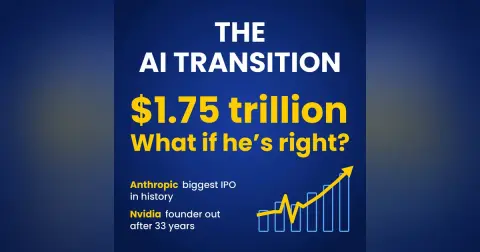
Dario Amodei told investors that cancer, Alzheimer’s, heart disease and mental illness could be relics of the past in less than a decade. Then Anthropic listed, and closed its first day worth around US$1.75 trillion.
This week Stephen and Lauren try, with mixed success, to stay hopeful. What if the promise is even a quarter right?
We look at where AI-discovered drugs actually stand, with about 173 programs in human trials and none approved yet. We cover the run of maths and physics results coming out of the AI labs, and why a proof is a long way from a treatment. Then two small, real wins: a Perth team using AI to read heart risk from bone density scans, and a 15-minute Gemini set-up that tamed one family’s school inbox.
And the fly in the ointment: Nvidia loses its founder after 33 years, amid an alleged spy scandal and questions about chips bound for China. How fragile is the thing paying for all this?
Plus a dad joke bad enough to prove comedians are safe from AI.
If you enjoyed this, please like, subscribe and share. It really helps. And remember, you still matter.
Chapters
00:00 Dario’s promise and the $1.75 trillion IPO
03:32 Selling shares, curing cancer: the pitch vs the drug pipeline
08:45 Maths and physics: what AI has actually cracked
13:32 Small real wins: a Perth heart scan and a school inbox
21:47 Nvidia, an alleged spy and the chips
27:57 Dad joke and where we land
The AI Transition is hosted by Stephen and Lauren. We cover AI developments with honest, human-centred analysis — no hype, no doom, just the questions that matter.
Subscribe wherever you listen to podcasts.
Follow us: https://www.aitransition.show/
The AI Transition is a People Over Process production.
You still matter. At least for just now.
You know, if today we look at things like cancer, Alzheimer's, heart disease, mental illness, these will be relics of the past in, I think, less than a decade. And I believe that the company which gets the risk right will also be the company that has the license to operate, that society trusts and society believes can build the benefits in the right way. I think if we do this right, we can create an age of miracles where humanity is able to solve problems that have eluded us for millennia. We have to make sure that all the risks, all the ways that things can go wrong with this technology, we very carefully address those risks as we bring the benefits and as we have a viable business at the same time. And I invite you to join us on the next phase of this journey.
SPEAKER_01So that was Dario Amade, CEO of Anthropic, as part of the IPO Roadshow. An IPO that as of this recording is now the biggest IPO in history at over 1.75 trillion US dollars. This is the I transition in with me as always, is Lauren.
SPEAKER_02Steven, what an opening. I mean, I'm inspired. There's butterflies, there's science, there's a guy nodding and gesturing and problems.
SPEAKER_01So what so when we watch that again, it was the hand gestures that really got to me as well. They
SPEAKER_02got and the head
SPEAKER_01and the head swayed. Looking away, and the
SPEAKER_02head tilt and the hands, yeah.
SPEAKER_01So are you excited? Are you part of the this this amazing decade of discovery that we're entering just now?
SPEAKER_02Oh, all the problems are going to be solved in the next 10 years, right? All of them.
SPEAKER_01Well, the market has the market spoke last night and uh it looks like it.
SPEAKER_02Oh, it's wild. What were the numbers? It was a 1.75 trillion.
SPEAKER_01Yes, it briefly went to over 2 trillion. It's hovered around about 1.75 trillion. It's only
SPEAKER_021.75 trillion.
SPEAKER_01Yeah. Each of the six founders, I think, got something in the region of 20 to 30 billion each. So Dario is probably quite happy this morning, along with some of his pals.
SPEAKER_02Morning. How would you like your coffee? Oh, like it's incredible, isn't it? Because it's still just based on a, you know, uh a bet and a hunch that this is all gonna come together.
SPEAKER_01But look the world. So so let's try this episode though, of go with a positive. Let's try and put us into this mindset of just say it's right, or even vaguely in the ballpark that this is going in the right sort of direction. That you know, in in in less than a decade that you're going to have these major things like cancer, Alzheimer's, heart disease, and all mental illness. So I think we could maybe put that one to the side because I I'm I'm betting that there's still going to be mental illness in 11 years' time. I I'd yeah.
SPEAKER_02What could that have been caused by in that time frame?
SPEAKER_01Maybe a huge disruption with everyone losing their jobs. But let's let's not let's not so let's let it go to the doctor. It's a bit
SPEAKER_02stressful, doesn't it?
SPEAKER_01Right.
SPEAKER_02Oh no, we've already just we've already lost
SPEAKER_01So but let's let's try and dig into that a little bit more. Or just say, but just say that some of this I was gonna call it hyperbole, but that's already me saying kind of showing my slight cynicism around this. Dario's own words back in August was saying that I will cure cancer is more cliche than inspiration. And most people think it's deceptive. But he said the way to win sceptics over is to actually do it.
SPEAKER_02Right. And
SPEAKER_01and so, you know, three months later, this is his pitch now, and now he's given it to the market, and the market said, Yay. Um
SPEAKER_02The market believe him.
SPEAKER_01He's been saying this sort of stuff for for for a number of years, of within five to ten years there's going to be these dramatic step changes. And i you it's probably worthwhile exploring a little bit his own personal background because I believe that he was treated for early stage cancer himself early in his life. And I and I think his father did die of an illness that became curable a few years later. Get the desire. I truly understand the desire that he thinks that he is creating something here which is going to make a step change of a difference.
SPEAKER_02Look, and that what it's important to remember that it's coming from a good place. And that's I guess what I was hopeful for with AI as well, right? The amount of data and hypotheses you can churn through so much faster, right? Obviously, um, a few other things need to line up. Hopefully, you know, we get a bit more funding, dare I say. We need to get some more, you know, humans funded back in to actually support how you actually work through those trials, right? So AI is obviously one part of it. You still need to get those humans in there to test them. And unfortunately, probably some animals. Um But the there's it's coming from a good place. I don't know how I could probably keep saying that over and over again, Stephen. Well, what um crops up for you?
SPEAKER_01Well, I was I was looking into the actual data of what's happened this year. And earlier this year, there was 173 odd AI discovered drug programs that were in human trials early this year, right? Now none of them have been approved so far. So in the last 12 months, yes, there are, you know, a couple of hundreds and it's there. The furthest along, I think, is uh rentocerebtid, which is for lung disease, uh, and it's now dosed its first patient in a phase three uh in September, right? But it also shows how how long and how difficult this process is. The problem is a step change difference from when, and we'll come to this in in a minute, when you're dealing with mathematical or physical problems or physically physics problems or you know, computer science and programming and the rest of it, because when you're dealing with actual humans and bodies and people's lives, there's a couple more checks than you just need to make sure that all your unit tests and your continued integration is all flashing green and you're done. There are processes that need to go through.
SPEAKER_02Exactly. We talk about this all all the time too, like even in software development where you've optimized the software development and maybe the testing, but all the feeding processes, governance that comes in, there's all that waste in there. And you're still going to face into this. But you know, like you said, even if we get maybe a quarter of this improvement, that's still a huge leap forward.
SPEAKER_01And I and and linking it back to the IPO, what comes up for you when you hear that promise from someone who's selling shares who then becomes a multi-billionaire, you know, a couple of weeks after it. How does that affect the message in what he's saying?
SPEAKER_02I mean, I think uh uh the world is now very much clued onto these very wealthy tech bros trying to sell us this dream, which has has a massive sting in the tail in terms of where it hits us. So now that I feel like it's just looking for more positive stories around what these technology can do. Use your critical thinking, Pete. It's like, where do you think this might be coming from? I do want to be hopeful because, like you said, it's you know, there's some devastating illnesses out there. And and look at, dare I say, can't believe I'm well, it's probably an obvious connection, what we were able to achieve in the pandemic under pressure in terms of vaccines and um so you know, it just needs to be that impetus, and it surely it can't be that a bunch of tech bros are getting incredibly wealthy.
SPEAKER_01The double-sided coin with this, from my understanding and uh my experience, there's a there is amazing technology here. You know, that this is a step change technology-wise. You know, what you can do, what you will be able to do in research and in automated research, and uh tying together so many disparate disciplines, which from a communication point of view in the past has been difficult, there there is a step change here. But I I find it really hard to untie that to this massive charge into wealth at such an extreme side of that you that we've not seen in centuries that there's this disparity now between such a small group of people who are controlling this. And we are completely in hock to whether the this is right or not. And I find that hard to hold those two thoughts at the same time.
SPEAKER_02Same. And and you know, it was said you can speed up how you tune through the data, but hopefully they're using some of those billions, right? If it's truth, this is really where he wants to go, pouring that into science and actually, you know, making sure that we're coming at it from both sides of this, not just uh the the you know, AI will be able to solve cancer on its own. No, you've still got to get all the testing and everything lined up.
SPEAKER_01I and when you were saying pouring that into science as well. Well, so if we kind of to talk about what's happened in the kind of the maths and the physics world over the last over the last couple of worlds, because there's been some big step changes there. But these things that AI has been able to do, they've been done inside the labs themselves, as in not not clinical labs, but inside the frontier labs, inside Anthropic and inside OpenAI. You know, the re-research in quotes is happening there, not necessarily happening, getting driven by the existing actual labs that are that are out there. But if if we if we cover what's happened, if you go back to early September, where you know the big one that the OpenAI came up with, which was one of the million-dollar math problems, which was the Navier-Stokes one, on which is about how fluids flow. There was a little bit of controversy there of whether it had solved it on its own or whether it had actually been using the data that had already been uploaded by some researchers that actually worked at Anthropic. And it was all very complicated. But anyway, but anyway, but machine checked and supposedly it settled. And you know, it fixed that one, which had been one that had been around for a long time. And then a month later it published another 722 papers of AI-generated maths solutions, and it's you know, we're going through those just now. So but it's happening inside the labs, not necessarily it's not funding this research to happen within the universities, for example, that they're using this technology. It's it's still for me coming over as a sales pitch, is all of this just going to be within these two companies going forward and you wouldn't need anyone else at all?
SPEAKER_02Yeah, exactly. And it, you know, it and dare I say, it all comes back to some of this that stinks as well, is how the models are being trained. But again, I'm all about for me, like like you said, investing in humans, like, okay, we'll bring that funding back into the universities, grow some more scientists, like have that human element in there so that we don't all go, oh, okay. So we'll just blindly believe the machine, checking from inside that one lab that's now gone live. Again, I I want to believe, and I don't know what that voice is. We'll figure that out later on.
SPEAKER_01But look, we're staying positive as much as we can in this. We're staying positive, right?
SPEAKER_02Keep trying, keep trying.
SPEAKER_01So in November, you from a physics point of view, because they they went from, well, we've fixed maths, we're now going to go and off and fix the
SPEAKER_02physical.
SPEAKER_01Physics, fix the mass,
SPEAKER_02it's a physics.
SPEAKER_01And there was a committee led by one of the Nobel physicists, David Cross, who confirmed the Yang Millis existence proof.
SPEAKER_02I mean, who isn't talking about the Yang Millis existence proof over when we catch up for a coffee? What a tea, Stephen, what do we first talk about? Okay, Yang Mill's existence proof.
SPEAKER_01And and this just isn't just existence, this is existence in 4D.
SPEAKER_02Oh
SPEAKER_01so this is the
SPEAKER_02basic stuff we all chat about.
SPEAKER_01And it builds on the 1980s. I'm going to have to read this because I actually don't understand what any of the words mean, right? The 1980s renormalization group and lattice approach to establish a continuum limit and relativistic quantum field theory in four dimensions.
SPEAKER_02We've solved physics, everyone.
SPEAKER_01So But that one's done. So actually we don't need to understand that one because that one's been fixed.
SPEAKER_02And uh you know, they've confirmed the other half. The mass gap is still open. That's what we're all wondering, that mass gap. Sorry, I've gone to I've got the I've got the cilies on.
SPEAKER_01But the but these are problems that people haven't been able to crack for 50 to 100 years, and there there's there's significant things there. But going back to what we said about the medicine as well, there's there's such a long way, and we've been involved in actual change, you know, within large organizations for for such a long time. There's a long way from coming up with the idea and how you know how to fix things to then actually implementing it and rolling it out. Right. There is a there's a there's such a gap there. So even if all of this is right and and fantastic, right? The the operationalizing that, the actually pushing that out into into the world and from a maths and physics point of view, that's one thing, right? Because it's equations and updating stuff and the rest of it. But when you're talking about curing all cancer within 10 years for 8 billion people, do you know actually as I said that my my real concern is that they do cure cancer, but for a very, very, very small percentage of the world. And it's the people who can afford it, because actually this is the people who are the billionaires, etc., who can afford this treatment and because that's where it's getting rolled out to. Sorry, I'd tried this this episode's so hard, so it's so hard to
SPEAKER_02do that.
SPEAKER_01Stephen we were positive.
SPEAKER_02We were at scamming the mass gap was open and you linked back to the rich curing their own illnesses.
SPEAKER_01I did. I did. Right. Well, we've got a couple of other examples, right? Okay,
SPEAKER_02let's
SPEAKER_01So why don't you give us the one from Perth and here in Australia?
SPEAKER_02So good news from Perth. Shout out to Perth Peeps. The Edith Cohen University professor Professor, Professor Josh Lewis. Um they've uh basically leveraging AI. Um we've got AI that reads the side view of spines taken to a bone density machine. If um anyone of a certain age has recently had a DEXA scan. Shout out. Uh you could score the calcium in the main artery running down to the belly, right? And this is some really good, you know, early signs where we've got calcium that's linked to the higher heart attack and stroke risk, which sadly is all through my family. So it's a it's a concern close to home. So it can show up before any symptoms, right? So now you've got your bone densing machines, you can see your calcium scores and actually get out ahead of this, which is incredible. So local advancements in Perth, funded by the Heart Foundation. This is kind of what I was linking to before, like really connecting science through and funding your health to work aside this. So the AI scored about 53,000 people's scans, and the highest scans went with more heart attacks and strokes over about four years. So this is that, you know, slightly longer study. It's observational, but really promising early warning science. So that's what you're looking for, right? Those tangible, it's coming together, here's the scans, here's the actual technology helping. So that's where I do feel a little bit more hope. Stephen, we've turned it around, here's some hope.
SPEAKER_01And and and it's one of Dario's four that you know, you know, heart disease is going to be fixed within the next 10 years, right? But staying not cynical. The study was here before AI. It's now using AI in order to build on top of that and to accelerate the benefits potentially that's coming out. I mean, you're saying about your family connections, and I'm the same, and I'd probably like to call out as well, and people can probably tell by my accent, you're originally from Glasgow, which is one of which is one of the worst heart measures in the whole of Western Europe and the world, because we were basically brought up eating deep fried pizzas for lunch and and and other such things. That's a true, that's true, actually. I used to have that when I was when I was at school. Deep fried pizza supper. Yeah. And they would get a pizza out of the packet, throw it in the deep fryer, and have that with chips.
SPEAKER_02And they wonder,
SPEAKER_01and they wonder why heart disease is such an endemic thing. But instead of fixing the not eating deep fried pizza, hopefully, we're gonna get a magic pill, hopefully, that's gonna fix all this. Now,
SPEAKER_02one little Stephen, time for your Dexter scan. Um Yeah, like it's it that lifestyle is amazing, right? But if you come back to this, like you've got 700,000 Australians getting that bone density scan each year. So if we included that side view that they're talking to, like AI can give you that second answer literally in seconds and flag that this is a risk and then you know get you to that specialist. So that's incredibly positive.
SPEAKER_01And it's a small tangible example of that there are things that are being accelerated with AI. If there was more focus in this rather than creating dancing penguins and and the rest of it, or doing cyber hacks, which seems to be the main thing that's in the in the papers just now, there are absolutely really good, important, legitimate uses. I I think it's going to take a lot longer than the 10 years in order to fix the four things that Dario's just promised in his IPO. You know, it might take 50 or 100 all in, but it's on the right track. You know, and in our lifetime, maybe there will be big advances in each of those areas, which would apart from the mental health one, I actually agree with that, that one's not happening. But the other three? With the other three? I you know, hopefully there can be more and more investment in there and people can see the benefits. There'll be guardrails to say this is where we should be investing this technology in, and that could be so beneficial to society.
SPEAKER_02Huge. And we've had a few of these little case studies along the way. Just even little, you know, uh, I think the example we had last time was where we had the young um surgeons identifying just how long it was taking to kind of triage their patients and bringing AI in to optimize that. Um, this is where I I do get excited and you bring the two together to to have these good news stories. So more and more funding of this kind of research, methinks, would help. So billionaire tech bros or new billionaires, walk the talk, buddies.
SPEAKER_01Indeed. Really small example, right? Away from medicine. I just I'm trying to, I was I was looking around for what other things could we share, the positive things that was going on. I just wanted to share a very small one in my own life as well. And and that was around using Gemini in my own personal life. I've started playing around with that, you know, which is the Google one, which is much more integrated in with if you're if you're an Android user and a Gmail user, then you know, Gemini is fully integrated in it. That's and it's interesting what it can pull out and guide you. So I don't want to go into the whole privacy and what happens there just now. I just want to say one positive that happened to me this week. And and that was around so I've got two teenage girls, life is just chaotic nightmare,
SPEAKER_02as
SPEAKER_01you can imagine. The communications that come from the schools and stuff these days, uh is just overwhelming, right? My daughters are overwhelmed with it, right? And but and and if I even just try and look at any of it, I'm completely overwhelmed with it all that's there. The amount of comms that's there, the amount of things to read, staying on top of it, etc. So what has helped me is setting up a weekly scheduled task within Gemini, which was pulling together all the school emails, comparing it to the calendar, comparing it to some other resources that were there that had been shared from the school, and and then it also has a look at our Google family calendar for other things that the kids might be doing or involved in, and then just giving me my wife uh a sheet at the end of the week to say, here are the things for next week that we need to look out for, and there's swimming on Wednesday, and she needs to bring a bottle in for the science exam on Tuesday, and she needs to prepare for her French on the Thursday more, and just giving us a checklist to to print out and put on the wall. I I initially I I couched it as that this was something to be really good for my daughter. Do you know what the real truth is?
SPEAKER_02It's really good for you.
SPEAKER_01It's me.
SPEAKER_02It's nothing to do with her.
SPEAKER_01It's absolutely nothing to do with her, it's all about me, right? Because I because I couldn't cope. She in fairness, she was probably coping quite fine with all this. I wasn't coping, and I just didn't have the time in order to do it. So it it it's a it's a small one, right? It took 15 minutes to set up. I'm I'm less stressed about it. I think I'm on top of things. Uh I I don't have time to check whether it's hallucinating or not. So so if I do send it off swimming on a Tuesday and there's no swimming on a Tuesday, I don't know, right? So I I can blame the bots for that one. It it's a small, tangible one. It's not the DEXA scan, right? It's not curing, you know, cancer, etc., right? But it's something useful, tangible in daily life.
SPEAKER_02And it's it is like you said, you know, you're all busy people, and look, I don't have kids, but I can imagine all these, you know, however many teachers they've got for all the different subjects, sending messages through. They're all jumping across the top. And I've got some amazing teacher friends too, but even imagine them trying to cross-coordinate, like it could just get so messy. So it's an example of, you know, just these little things that reduce that cognitive load and hopefully free it up a little bit, you know, for some other good things like on this podcasting.
SPEAKER_01These two examples that we're giving you, the the actual proper one, which is you know, DEXA scans, etc., and then me being able to try and not have a nervous breakdown while looking at my my my daughter's school emails. Neither of these are are medical stuff. They're not they're not rocket science. And both of them still have people in the loop as well, right? So so this is for me to be consumed by me in order to help what was going on. So it's an aid, you know, what's happening with the DEXA scan stuff. It's not this as a an automated system that you just go in and get scanned by a robot and it gives you a magic pill and all humans are out of the loop. Anything but you know this is helping doctors and researchers, etc., to do more and to scale more and to potentially to achieve more and not taking people out of the loop. Look, we can't do a positive episode without maybe but a little fly anointment somewhat. Because
SPEAKER_02where are we going?
SPEAKER_01Because because guess what might undermine all of this the wonderful Nirvana? Utopian type stuff.
SPEAKER_02Let me see. Could it be the wilds of a honeypot from uh China?
SPEAKER_01It could well be a honeypot spy Chinese sex scandal thing going on. This
SPEAKER_02was I feel did all of us take a little bit of delight in this that this ridiculous thing happened. Like we've got Nvidia underpinning a lot of well, we shouldn't laugh about this bit, but underpinning the global stock market. And uh the founder, Jensen Wang, he's a busy boy, isn't he, Stephen?
SPEAKER_01He certainly is. And what an in fairness, it wasn't just the honeypot alleged spy, sort of spy.
SPEAKER_02Correct.
SPEAKER_01Um you know he he was busy with at least two other employees at Nvidia at the time as well, who are his dating direct reports.
SPEAKER_02Does he have all his time?
SPEAKER_01For a 63-year-old man, I mean that's you know so I I couldn't help thinking of like Austin Powers type stuff when reading into this. Because it's it and that was the image that I got was Austin Powers. That was him, and he was just bumbling around and
SPEAKER_02But now I'm distracted because I had not thought of that angle, and that is hilarious.
SPEAKER_01Oh
SPEAKER_02no. Now I'm thinking about where she's putting the secret.
SPEAKER_01Don't let's not go there. Let's not go there. Let's not go there. But the the the sad reality of the way that the world is constructed just now, we alluded to it back at the beginning of that there's this small group of tech bros, and unfortunately they are all bros, right, who have such oversized impact into the world and particularly the financial markets, etc. And so so Jason Wang wasn't just the CEO of NVIDIA, and NVIDIA weren't just making the GPUs, they're basically the bank for the whole AI boom. Nearly all the deals were getting done because actually I don't know if you read this. So so he didn't believe in a pyramid type structure for a corporation. He believed in the kind of uh the wheel one where you've got the spoke and then the and then the hub and spoke in the middle, and he was the hub. He had 60 direct reports, 60.
SPEAKER_02Well, of course he was the hub, Stephen.
SPEAKER_01So when you've got so it's all down to him. You've got this five trillion dollar organization that is the bank for all these other AI companies, because basically they're involved in what you know, allegedly circular financing, where basically a startup company will come to them and they'll say, Hey, we've got this great idea, and then video go, Do you know that's great? Here's five billion dollars, but do you know what? You've got to buy five billion dollars of our chips, and then we'll put it on our balance book, and then we've all grown, and there's this extra five billion dollars, and everyone goes, Great, rinse and repeat that hundreds of billions of dollars. And Jason was at the heart of that for doing those deals, and many times on a handshake and a wink and a nod. Um I can't.
SPEAKER_02Say what else.
SPEAKER_01So looking into the story, you know, that's that's when on it's it's actually moved well away from the honeypot sex scandal type stuff. It's actually more about that circular financing that and it's potentially ships to to China, um you've since the 20% of the whole of the NVIDIA revenue is going through China. So there's so many layers to this. But this one man falling with this with this Austin Powers like scandal that's there could could be the thing that that pops the whole bubble, that then brings down eventually anthropic and stops the cure for cancer in ten years' time. Oh
SPEAKER_02my god, and then look, I'm a bit obsessed with SNL and how they're portraying that at the moment, and they did in uh weekend update make a joke that you know we might all end up paying for his divorce, basically, because it's underpinning all our super.
SPEAKER_01Yes.
SPEAKER_02Um, like you're saying, and this is where it does get a bit wild. Alice Huang, a relation. She's a Chinese businesswoman who did exactly what you said, right? She came in, bought billions of dollars of NVIDIA chips, um, and but they said oh Mega Speed was the company that she was running that she left in 2025. And you're like, oh God.
SPEAKER_01And and and those and those chips, so when they went to the data center to see those chips, they weren't there. In fact, and some of them were sitting in a warehouse, and the other ones, I'm not quite sure where they've gone, but it's fine. It's fine. It goes all the way up to the the senior parts of the American administration as well. Trump supposedly knew all about this a year ago. You've now got Besson and Luckneck, who are the two of the senior people in the Trump things who are there on different sides of the China angle that all this is tied up in. So it's there's so many layers. Uh and but Jason was so pivotal right in the middle of it. And and whether it was just the honeypot thing that got him, or this was used to bring him down, or whatever, but it could be that that pillar goes and then things unravel. Although, as of today, anthropic's worth 1.5 trillion dollars, a quadrillion dollars, whatever it is now.
SPEAKER_02Quadrillion, cabillion. Okay.
SPEAKER_01Yeah, uh the party's still rolling on for at least for just now. Which going back to the beginning, and we're trying to stay with hope that maybe we have to put up with all of that in order to have our cure for cancer and Alzheimer's and heart disease, but not the mental health.
SPEAKER_02No. Yeah, maybe it's this is what you've got to go through to get that outcome. It just seems crazy to even say it, right? But um look, it's they are a fascinating cast of characters, these tech bros, when you uh see them all together and the just the angles that they're coming from and yeah, how how we can end up in this one point, sorry, let me fa 1.75 trillion, right? Um, value based off a premise that it will, you know, do all of these things. So we do need to start seeing some results, and it is hopeful when you see what we're doing local locally, go
SPEAKER_01earth
SPEAKER_02you good thing.
SPEAKER_01Yes. Um
SPEAKER_02yeah.
SPEAKER_01So do you have a joke in order to take us out, Lauren?
SPEAKER_02Well, I did go down the honeypot path and it it was a struggle. Again, guys, I do not recommend any kind of AI tools for your bad puns and dad jokes, but I um this is one I did find. I'll let you be the judge here. How did the spy successfully honey trap the NVIDIA exec?
SPEAKER_01I don't know.
SPEAKER_02She used artificial sweetness to steal his intelligence.
SPEAKER_01Oh god, that's so bad.
SPEAKER_02It's really awful. I'm really trying hard to work on these, and really that was the best of a bad one. I'll take the groan. I'll take the groan.
SPEAKER_01No, yeah, that's that that that that that's a groan. Oh dear. Well, at least so so maybe being a comedian and stuff, that's the one job that's going to survive in 10 to 20 years. Because there's they're making zero progress on any of this so far.
SPEAKER_02Yeah, exactly. And I we I think we're both uh recommending that you go down a YouTube rabbit hole and check out the awesome work from Saturday Night Live, really tearing these guys to shreds. It's hilarious. But look, I think we did land on some positive things though, Stephen. Some local really good news stories that we're holding on to with the DEXA scans and the early warnings around heart disease. That for my mind is enough to give me some hope that we can see some progress here.
SPEAKER_01And and and just to be clear, that's that's that's more or less important than me being able to cope with my email inbox disaster.
SPEAKER_02I feel like that is a that is a bigger win, Stephen. I mean, as much as your inbox is important, and mine, mine too, I enjoy the ease of you know what these tools bring. But um, yeah.
SPEAKER_01So I look, I agree. Uh hopefully with all of this nonsense, all of these valuations and the Austin powers and the rest of it, uh hopefully there's value that's coming as well. And you know, we've we've delved into just a tiny little bit of some of the good stuff that's there. Anyway, thank you very much, Lauren. One wonderful again. And thank you everyone for listening and watching. So please like, subscribe wherever you are listening or watching this, it really, really helps. But most importantly, and I can't emphasize this enough these days is that you still matter. Thank you, Lauren.
SPEAKER_02Thank you, Steven.